Brass Tacks · April 12, 2013
Target Driven Zoning works!
Originally posted April 12, 2013 at 02:20 PM on brasstacksblog.typepad.com/brass-tacks/2013/04/target-driven-zoning-works.html
Recovered from the Internet Archive: post and comments, captured Sep 10, 2025 · archived page (PDF)
Thanks to EMC’s DJ Brown and some help from Blayne Rawsky at Brocade, we finally have TDZ running in the lab. The first peer zone was successfully registered on 3:55 PM EDT on Thursday April 4th 2013.
Test configuration
The test configuration was deliberately kept small and is shown below.
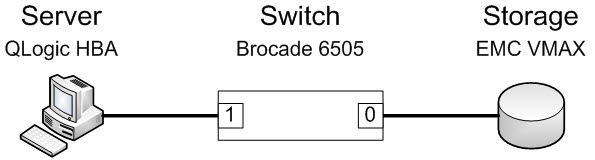
The Server is a Cisco UCS C Series server running SLES11SP2 with a QLogic 8GHBA installed in it.
The switch is a Brocade 6505 that is running a special test version of FOS with rudimentary TDZ support.
The Storage is an EMC VMAX that is running a special TDZ capable debug version of Enginuity.
The protocol
As shown in the xgig trace below, as soon as the link came up between the Storage and the Switch, the storage port transmitted a GAPZ (Get Active Peer Zone, command = 012A) and the switch rejected this request because there was no peer zone registered yet. This is normal and expected behavior the first time a storage port initializes.
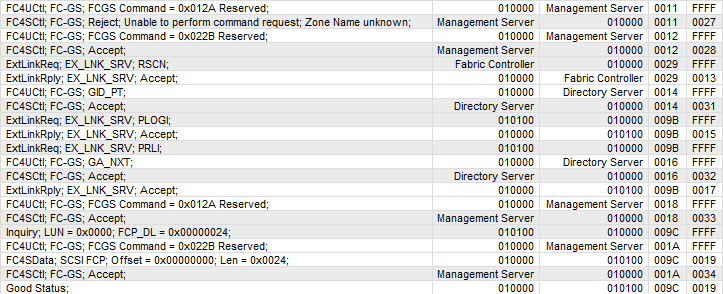
The storage then transmits AAPZ (Add/Replace Active Peer Zone, command = 022B). The storage uses
this command to register the peer zone with the switch. The result of this command is shown below in
the cfgshow output.
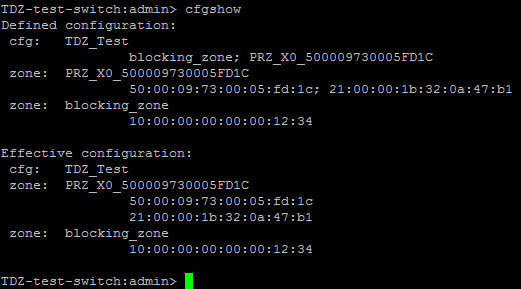
Notice the zone name of “PRZ_X0_500009730005FD1C”. The zone members are the WWPNs of the VMAX port (starting with 50:00) and the QLogic HBA (starting with 21:00). This zone was created by the switch in response to the AAPZ command that was sent by the VMAX port.
Another important point to note in the xgig trace is the PLOGI and PRLI after the RSCN. These requests
were from the host and I’ll simply point out that the QLogic HBA automatically generated these login requests after it received an RSCN. The RSCN was generated by the switch in response to the zoning change that was initiated by the VMAX registering a peer zone. The fact that the host automatically detected the zoning change and logged into the storage port is due to the way that FC Discovery works and TDZ leverages this behavior so that it can function properly even though no changes were made on the HBA to allow the TDZ functionality to operate correctly.
Next steps
The next steps are to scale up the number of ports and prepare for a demonstration at EMC World in May. I’ll provide more detail about my sessions and when you can see TDZ working in a subsequent post.
In regards to product plans for including the TDZ functionality, there are none. However, I’m hoping that if we get enough positive feedback on this blog post and at EMC World that we’ll be able to convince both Brocade and EMC to add it to our roadmaps and into your environments as soon as possible.
Thanks for reading!Comments (4)
-
Nigel Poulton · 05/09/2013 at 03:00 AM
-
fausto · 05/09/2013 at 04:46 AM
Is TDZ compatible with FC alias? I mean, can I see human readeable names associated to pWWN on the zone that gets created?
-
Erik · 05/15/2013 at 12:18 PM
Hi Fausto, yes, TDZ is compatible with Aliases.
-
Rahul · 05/29/2013 at 06:52 AM
Hi Erik,
Great Work !!
I think this looks very promising. Did you had a chance to develop and present this in EMC World ?
The comments to this entry are closed.
Erik. Cracking piece of work and a technology that makes a lot of sense to me, and therefore one I think the vendors and standards guys should pursue.